
Anatomy of the Chimera
Lion, goat, serpent. Three creatures fused into one -- the monster that gave Himara its name.
The Chimera (Greek: Χίμαιρα, Khimaira) was not assembled at random. Ancient poets gave her a specific body plan: lion in front, goat in the middle, serpent behind. Each classical source adds detail, and each sometimes contradicts the others. Below is what they actually said -- and where they disagreed.
The word khimaira means “she-goat” -- the feminine of khimaros. Both trace back to kheima (“winter”), because young livestock were counted by the winters they had survived. The same word became the name of an ancient settlement on the Albanian coast: Χίμαιρα, now called Himara.
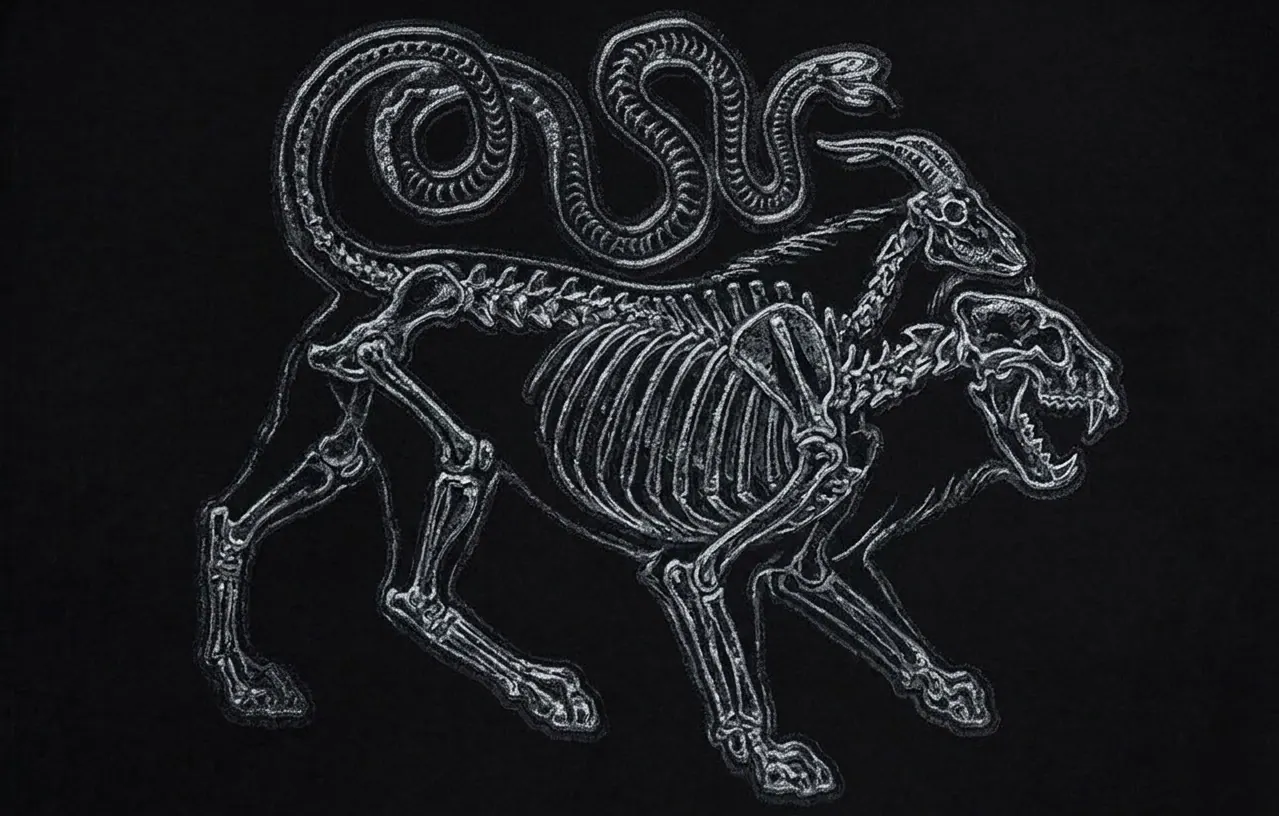
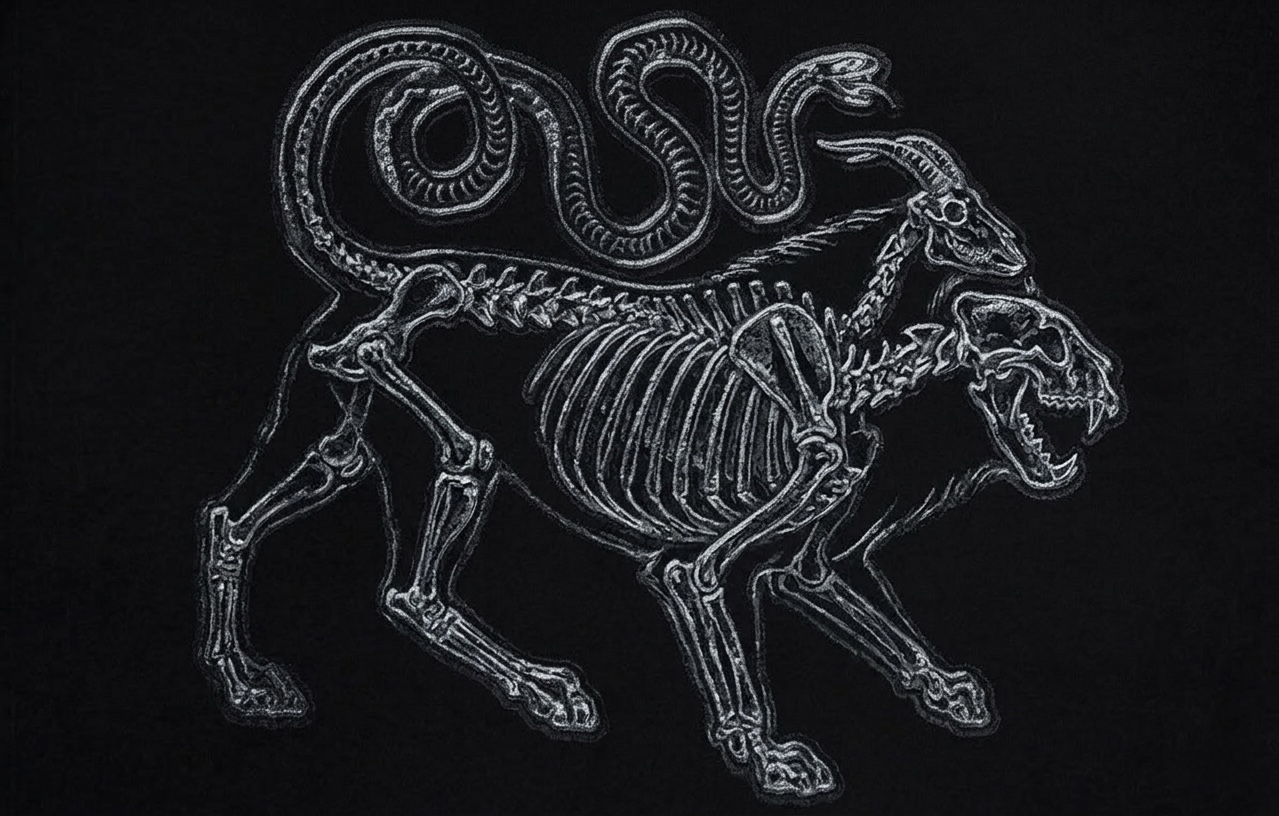
The Chimera’s three-part skeleton: lion forequarters, goat rising from the spine, serpent tail.
What the Sources Say
Homer, Iliad (c. 750 BC)
“...a thing of immortal make, not human, lion-fronted and snake behind, a goat in the middle, and snorting out the breath of the terrible flame of bright fire.”
Book VI, lines 179-182. The earliest surviving description. Homer gives us the front-middle-rear layout but is vague about the number of heads. He attributes fire to the creature as a whole, not to a specific head.
Hesiod, Theogony (c. 700 BC)
“Her heads were three: one was that of a glare-eyed lion, one of a goat, and the third of a snake, a fierce dragon.”
Lines 319-325. Hesiod makes the three heads explicit for the first time. He also tells us the fire came from the goat-middle section: “in her forepart a lion; in her hinderpart, a dragon; and in her middle, a goat, breathing forth a fearful blast of blazing fire.”
Apollodorus, Bibliotheca (c. 1st-2nd century AD)
“...front part of a lion, the tail of a drakon, and the third -- middle -- head was that of a goat, through which it breathed out fire.”
The most anatomically precise account. Apollodorus is the most explicit source stating that the goat head was the fire-breathing one specifically. He also says Bellerophon killed the creature from the air using bow and arrows while mounted on Pegasus.
Ovid, Metamorphoses (c. 8 AD)
“Lycia... where the Chimaera prowled with lungs of fire and lion’s breast and head and serpent’s tail.”
The Roman account. Ovid puts the lion as the primary body with fire attributed to “lungs” rather than a specific head -- a different interpretation from the Greek sources.
The Three Parts
The Lion
Every source agrees: the lion forms the front. Homer calls the creature “lion-fronted” (prosthe leon). Hesiod gives it a “glare-eyed lion” head. Ovid says “lion’s breast and head.”
The lion provided the body’s core architecture: muscular torso, four legs with clawed paws, a mane framing the primary head. In the Arezzo bronze -- the most famous surviving sculpture -- the lion body is rendered with extraordinary anatomical detail, every tendon and rib visible under the skin.
This was the head Bellerophon faced when attacking from the front. It was also the head that roared -- Ovid’s “lungs of fire” may refer to the lion’s breath rather than literal flame.
The Goat
The most distinctive feature. A second head -- that of a goat -- rises from the creature’s back, sprouting from the spine between the shoulder blades and the hindquarters. Homer says simply “a goat in the middle.” Hesiod and Apollodorus give it a full head with horns.
This is the part that gives the Chimera its name. Khimaira means “she-goat” in Greek. A creature with a lion’s body and a serpent’s tail might have been called something else, but the goat was the defining feature -- the part that made it a Chimera.
According to Apollodorus, the goat head was the fire-breathing one. This is the clearest statement in any classical source about which part produced flame. The goat breathed fire “through” its mouth -- not the lion, not the serpent. Hesiod concurs, placing the “fearful blast of blazing fire” in the middle section.
In the Arezzo bronze, the goat head is shown mortally wounded -- drooping, blood gushing from a spear wound in the neck. This is mid-battle: Bellerophon has struck the fire-breathing head first, neutralizing the most dangerous weapon.
The Serpent
Homer says “snake behind.” Hesiod calls it “a fierce dragon.” Apollodorus specifies “the tail of a drakon.” In practice, the Chimera’s tail terminates in a serpent head -- a third skull with its own jaws and fangs.
This gave the creature no blind spot. The lion watched the front, the goat surveyed the flanks, and the serpent guarded the rear. Approaching from any direction meant facing a head.
The Arezzo bronze’s serpent tail was damaged in antiquity and later restored during 1785 by sculptor Francesco Carradori. The restoration shows the serpent rearing back, mouth open, coiling as the creature writhes in its death throes. Whether the original tail was identical is unknown, but the concept -- a living, biting tail -- is consistent across all literary sources.
Fire-Breathing and the Wing Question
Which head breathed fire? The sources do not fully agree.
| Source | Fire Attribution | Heads |
|---|---|---|
| Homer | Whole creature — “snorting out flame” | Ambiguous (1 implied?) |
| Hesiod | Goat / middle section | 3 explicit |
| Apollodorus | Goat head specifically | 3 explicit |
| Ovid | “Lungs of fire” (lion body) | 1 implied (lion) |
The goat head is the strongest candidate for the fire source. Apollodorus -- the most anatomically detailed ancient writer on the subject -- says fire came “through” the goat head. Hesiod places the “blazing fire” in the middle section. Homer and Ovid are vaguer, attributing flame to the creature generally.
Did the Chimera Have Wings?
No classical text mentions wings. Homer, Hesiod, Apollodorus, Ovid, Pindar, Hyginus -- none describe the Chimera as winged. The Arezzo bronze has no wings.
But some ancient art tells a different story. Several Corinthian and Etruscan pottery pieces depict the Chimera with small wings, likely borrowed from other composite monsters in the Greek bestiary. These are artistic inventions, not literary ones. The canonical Chimera was grounded -- a predator of mountains and gorges, not of the sky.
The Arezzo Bronze
The most famous depiction of the Chimera in existence is an Etruscan bronze sculpture cast around 400 BC, discovered in 1553 near Arezzo, Italy. It now stands in the Museo Archeologico Nazionale in Florence.
The bronze captures the Chimera mid-battle. The lion head roars with its mouth wide open. The goat head droops from its wound, blood sculpted pouring from the neck -- Bellerophon has struck the fire-breather first. The serpent tail (restored in 1785 by Francesco Carradori) rears back with jaws agape. The creature is dying but still dangerous from every angle.
Art historian David Ekserdjian called it “one of the most arresting of all animal sculptures and the supreme masterpiece of Etruscan bronze-casting.” It bears the inscription TINSCVIL on the right foreleg -- Etruscan for “offering to Tin,” the Etruscan equivalent of Zeus.
A Family of Monsters
The Chimera was not born in isolation. According to Hesiod’s Theogony and Apollodorus’s Bibliotheca, she was the daughter of Typhon (a storm giant with a hundred dragon heads) and Echidna (half woman, half serpent). Her siblings were the most feared creatures in the Greek world:
Cerberus -- the multi-headed dog guarding the gates of Hades
Lernaean Hydra -- the many-headed water serpent killed by Heracles
Orthrus -- the two-headed dog guarding the cattle of Geryon
Caucasian Eagle -- the eagle that ate Prometheus’s liver each day
One contested passage in Hesiod (Theogony, line 326) suggests the Chimera mated with her own brother Orthrus and produced the Sphinx and the Nemean Lion. But the pronoun “she” in Hesiod’s Greek is ambiguous -- it could refer to the Chimera or to Echidna. Apollodorus assigns the Sphinx’s parentage to Echidna and Typhon directly, skipping the Chimera entirely.
How Bellerophon Killed the Chimera
King Iobates of Lycia sent the hero Bellerophon to kill the Chimera, expecting him to die. Bellerophon’s advantage was Pegasus, the winged horse born from Medusa’s blood, tamed with a golden bridle given by Athena. The aerial mount was essential: fighting a fire-breathing creature on the ground was suicide.
Two traditions describe the killing method:
Bellerophon mounted a block of lead on his spear tip and drove it into the Chimera’s throat. The creature’s own fire breath melted the lead, which poured down its gullet and solidified in its organs -- killing it from the inside.
Apollodorus says Bellerophon “flying high into the air brought down the Khimaira with his bow and arrows.” A simpler, more brutal account.
The lead-spear version reveals something about the fire-breathing anatomy: the mechanism was internal. The Chimera’s fire was hot enough to melt lead (327°C / 621°F) and traveled through a throat connected to the creature’s core. It was not surface flame -- it was a biological furnace.
From Myth to Science
The Chimera’s legacy extends beyond mythology. In modern genetics, a chimera is a single organism containing cells with two or more distinct sets of DNA -- typically from the fusion of separate embryos. The metaphor is precise: one body, multiple genetic identities, just as the mythological creature was one body with multiple animal identities. The first human genetic chimera was documented in 1953.
The Chimera also left its mark on the landscape. Yanartaş (ancient Mount Chimaera) in Lycia, Turkey, has dozens of natural gas vents that produce eternal flames -- some burning continuously for over 2,500 years. The ancients believed these were the breath of the monster herself. Pliny the Elder wrote that the mountain “burned with a flame that does not die by day or night.”
A 4th-century commentator named Servius proposed the most enduring rationalization: the Chimera myth was a landscape allegory. The mountain had lions at the summit, goats on the middle slopes, and serpents at the base -- directly mapping onto Homer’s front-middle-rear anatomy. This interpretation also resonates with the Albanian coast, where goats still graze impossible cliffs above the sea, ravines wind like serpents through limestone, and the golden rock face glows like a lion’s mane in the late afternoon sun.
The Chimera and Himara
The ancient settlement on the Albanian coast was called Χίμαιρα (Chimaira) -- the same word. Not “inspired by” or “named after” -- the identical Greek word for both the creature and the town. The connection was the goat: a land of wild, steep terrain where flocks grazed on near-vertical slopes above the Ionian Sea.
Over two millennia, the name evolved through the languages of the peoples who lived here: Χίμαιρα → Χειμάρρα → Chimara → Himara → Himarë. The sound changed. The meaning persisted. Today, the chimera icon on this website connects the modern beach town to its ancient identity -- a place shaped by wild mountains, torrents, and the restless sea.
For the full story of how the name evolved, see The Name Himara.
Explore the Land of the Chimera
The same wild terrain that inspired the myth still defines the coast today.